A factory is a way of storing knowledge.
Its walls know where material should move. Its machines know which motions should be repeated. Its schedules know when people should arrive. Its managers know how work should be divided. Long before artificial intelligence, the factory already knew more than any person inside it.
The great achievement of industrialization was not simply the steam engine or the moving line. It was the transfer of knowledge out of the craftsperson and into a system. A complicated act became a sequence of simpler ones. Skill became procedure; judgment became inspection; memory became a ledger; experience became management.
At Ford, the moving assembly line reduced the time required to assemble a Model T from 728 minutes to 93. The product moved; the worker stayed. That arrangement did more than accelerate a car. It established a durable grammar for production: divide, sequence, standardize, measure, repeat.
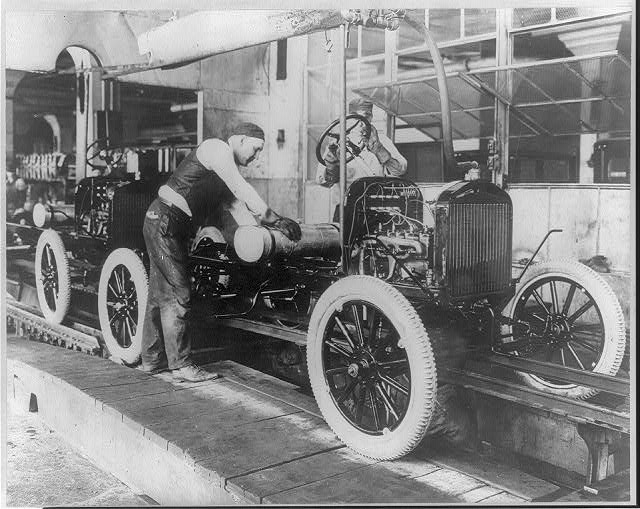
The worker no longer needed to comprehend the whole product. The factory held the whole. Its intelligence lived in the arrangement.
“They mistook changes in the outputs of the system of production for changes in the system of production itself.”Jorge Reina Schement and Terry Curtis, 1995, p. 212
That sentence was written about the information age. It also describes the mistake we are in danger of making about artificial intelligence.
The factory moved into the office.
In 1995, communication scholars Jorge Reina Schement and Terry Curtis published a book with an unfashionable argument. The information society had not burst into existence with the computer. It had developed across the twentieth century from the same forces that built industrial America: capitalism’s search for new commodities and management’s need to control organizations growing too complicated to see.
Information could become an industry only after people learned to treat it as a thing. A name, an equation, a picture, and a novel came to share an imagined substance called information. It could be stored, transported, measured, owned, stolen, and sold. An abstraction acquired the manners of matter.
Once information became thing-like, it could enter the factory’s grammar. Organizations divided its production into jobs, imposed sequences and standards, measured output, and built machinery around it. Across the twentieth century, information work grew until it occupied the majority of the labor force by the period Schement and Curtis described. The office looked nothing like the mill, but the organization of work remained recognizably industrial.
Management’s problem was visibility
Interconnectedness, in their account, was not simply people becoming closer. Large organizations produced uncertainty: no manager could directly see every transaction, worker, supplier, and customer. The answer was more reporting, more channels, more specialized information workers, and more elaborate systems of coordination. Each solution made a larger organization possible—and created the need for still more information.
This is the deeper lineage of the software factory. It is not merely a machine for producing code. It is a management system for turning ambiguous needs into work that can be assigned, observed, tested, priced, and governed. The repository is simultaneously workshop, record, communication channel, and instrument of control.
Organizes muscle
Organizes symbols
Organizes cognition
View the comparison as a table
| System | Primary input | Work organized | Quality control |
|---|---|---|---|
| Industrial factory | Material | Physical tasks | Inspection |
| Software factory | Requirements | Symbolic tasks | Tests and review |
| Agentic factory | Goals and signals | Tool-using cognitive tasks | Evaluation loops |
Schement and Curtis saw liberation and confinement arriving together. Information work could reunite intellect with labor for some people. But office work also inherited segmentation, deskilling, automation, surveillance, and alienation. The assembly line became less visible precisely as it moved closer to the mind.
They also saw an essential tension beneath the information economy: information carries social value, but markets allocate it according to private value. Who owns the code, the context, the models, and the traces is therefore not incidental to an AI factory. Ownership determines which knowledge becomes common infrastructure and which remains a proprietary advantage.
It became an information system.
Software was industrial before AI.
The phrase software factory sounds like a product of the present boom. It is almost as old as software engineering. In 1968, General Electric computer scientist R. W. Bemer proposed a factory intended to reduce variation in programmer productivity through standardized tools, a common interface, and a historical database for financial and managerial control.
At the NATO software-engineering conference that same year, Douglas McIlroy argued for “mass produced software components.” During the following decades, IBM concentrated thousands of programmers in its Santa Teresa Laboratory, while Japanese firms built organizations explicitly called software factories. Hitachi pursued process standardization, control, productivity, reliability, and software delivered as a product with guaranteed quality.
The modern development pipeline completes much of that program. Work arrives as requirements and issues. It is decomposed into tickets, transformed in repositories, checked by automated tests, inspected in code review, moved through continuous integration, deployed, observed in production, and returned as telemetry. The product travels between stations even when the people do not.
Software adds a strange property to industrialization: it can manufacture more of its own means of manufacture. A developer builds a compiler, framework, test harness, deployment system, or code generator; that tool then performs part of future development. The product can alter the process that produces the next product.
Still, conventional automation waits for instructions written in advance. A compiler does not decide what program should exist. A test runner does not invent the repair. A deployment pipeline does not reinterpret an ambiguous goal. The factory contains intelligence, but it does not construct a path through an underspecified task.
The instructions enter the loop.
The change is located between goal and instruction. A traditional machine executes a procedure specified in advance. An agentic system participates in constructing the procedure: it can interpret an issue, inspect a codebase, propose a plan, choose tools, generate a change, run tests, read the failure, and revise.
That is the bounded meaning of “thinking” in this essay. The claim is not consciousness. It is that work once reserved for the human side of the production boundary—turning an ambiguous objective into intermediate symbolic operations—has entered the machinery.
Vendors now describe systems spanning more of the development lifecycle. OpenAI describes coding agents that complete end-to-end tasks, work in parallel, follow encoded team practices, and perform scheduled background work. Factory describes an interconnected system in which agents implement, review, test, document, and respond to production signals. These are ambitions and product claims, not proof that autonomy works reliably in every codebase.
Independent evidence is more instructive because it is mixed. DORA’s 2025 study characterizes AI primarily as an amplifier of an organization’s existing strengths and weaknesses: outcomes depend on the surrounding system. In a randomized study of experienced open-source developers working in familiar repositories, METR found that early-2025 tools made participants 19% slower, despite their expectation that AI had accelerated them. Neither result settles the future. Together they puncture the idea that adding a model automatically creates a productive factory.
The programmed factory
- Human decomposes the goal
- Human writes the instructions
- Machine executes predetermined operations
- Human interprets failure
The agentic factory
- Human supplies intent and boundaries
- System proposes intermediate instructions
- Agents choose tools and transform artifacts
- Results are evaluated and used for revision
The contemporary factory combines repositories, models, tools, controlled execution environments, traces, evaluations, and orchestration. None is cognition by itself. Their organizational novelty lies in the loop: the system can receive an underspecified signal, construct and execute a provisional path, observe machine-checkable consequences, and alter the next step.
Calling that thought is intentionally uncomfortable. Models generate fluent errors. Evaluations encode only the qualities their designers know how to measure. The system bears no legal responsibility and may have no understanding of the consequence it produces. But it performs enough of the outward organization of cognitive labor that the old boundary—people issue instructions, machines execute them—no longer describes the work.
The line helps decide how to make the product.
Who works for whom?
Schement and Curtis called their book Tendencies and Tensions because the information society could not be reduced to progress or decline. Every tendency brought a counterforce. Interconnection enabled coordination and dependence. Information work offered intellectual fulfillment and new forms of control. Expanding media brought knowledge and overload. The market produced information abundance while withholding what could not profitably be sold.
The AI factory inherits all of these tensions. Its character is not determined by the model alone, but by where people place authority around it.
Who holds authority?
Assign each decision to people or agents. The arrangement—not the presence of AI—determines what kind of factory you have built.
Agents perform implementation, but people retain the model of the whole, judge the result, control release, and own the consequence.
The workshop
One person equipped with agents may recover something industrialization took away: the ability to hold the whole product. Instead of contributing a narrow task inside a large organization, a small team can move from idea to implementation, testing, deployment, and operation. AI can reunite conception with execution—but only where people retain meaningful control over the work.
The panopticon
The same machinery can make intellectual labor newly legible to management. Prompts, traces, evaluations, acceptance rates, cycle times, and agent comparisons translate cognition into measurable events. The factory does not merely automate tasks; it can observe and standardize the paths of symbolic work.
The hollow ladder
Factories historically remove or simplify the tasks from which novices learn. If agents absorb routine implementation, debugging, documentation, and review, organizations may gain immediate output while weakening apprenticeship. Early studies of novice programmers already find that generative tools can either accelerate learners or compound weak mental models. The long-run effect on professional formation remains an open question, not a settled outcome.
The responsibility gap
A system can propose a plan, write the code, run the tests, and recommend deployment. But it cannot own the consequence. As operational agency moves into the production loop, responsibility can become distributed across model provider, toolmaker, operator, manager, and organization until no one feels entirely accountable. Governance is the work of preventing that diffusion.
Are AI software factories replacing industrial organization—or perfecting it?
Schement and Curtis warned that visible technological change tempts us to declare a break with history. New machines dominate the imagination; older systems of ownership, management, and distribution recede into shadow. The computer did not dissolve industrial capitalism. It extended its reach into information. AI may do the same to cognition.
The central question is therefore not whether the factory truly thinks. It is who defines its goals, who owns its memory, who benefits from its output, who can challenge its decisions, and who answers when it is wrong.
This argument begins with Jorge Reina Schement and Terry Curtis.
Their achievement was to locate the information age not in the spectacle of new devices but in older arrangements of work, markets, institutions, and power. In the book’s preface, they explain that years of collaboration made their interpretations “no longer distinct,” so they merged their work. The continuity thesis belongs to both authors.
They showed that information work could remain industrial work even when the factory floor became an office cubicle. They described how the mind could become part of production; how organization could deskill and automate symbolic occupations; how interconnectedness grows from the need to manage uncertainty; how workers might gain autonomy while losing the boundary between work and home; and how technological images can obscure human choices.
Schement’s wider career kept returning to the distributional consequences of information systems: information poverty, universal service, language, media ownership, and the persistent gaps between people a network reaches and people it serves. That work adds an essential question to the software factory. It is not enough to ask what the system can produce. We must ask who can direct it, whose knowledge it contains, and how its benefits and burdens are distributed.
Thirty years later, their framework lets us see the software factory as more than a new machine. AI did not bring intelligence into an otherwise mindless institution. Factories have always embodied intelligence—in machinery, procedure, division of labor, standards, and management. What changes now is that the intelligence embedded in the organization can express itself in language, operate tools, construct intermediate instructions, and modify the symbolic machinery of production.
Whether that expands human authorship or intensifies industrial control is not a technical destiny. It is a choice about ownership, authority, and the organization of the factory that is learning to think.
“The information society should be thought of as a development in the evolution of industrial capitalism.”Jorge Reina Schement and Terry Curtis, 1995